The basics
What is Gymlytics?
Fantasy for NCAA Women’s gymnastics. You draft a roster of real college gymnasts, and the scores they post at real meets are your team’s scores. Nothing is simulated and no points are invented on top of the sport.
The whole game in three lines: Draft a roster of NCAA gymnasts. Each week, set who's up on each event — their top 5 scores per event count for you (by default). Your weekly total is ranked against your whole league. Season standings drop your two lowest weeks.
What does a season look like?
The NCAA Women’s season runs January to April, with meets every week. Gymlytics drafts in the weeks before it opens and scores every week of it.
The app moves through four phases, in order: pre-draft → drafting → in-season → postseason. They are app-wide rather than per league — there is one NCAA calendar, so every league drafts in the same window and finishes at the same championship.
Am I paired against one other team each week?
No. Your weekly total is ranked against every team in your league at once, so there are no pairings, no byes, and an odd number of teams is completely normal.
Tied totals share a rank, and the rank after a tie is not skipped.
- 01Pre-draftTeams form, lists get built
- 02DraftingRosters are drafted
- 03In seasonWeekly lineups, January to April
- 04PostseasonChampionships, final standings
Getting started
How do I get into a league?
Three doors, and they all end in the same place — a team with a draft list. Start a private league and invite friends, join one with an invite code, or start a team on its own. Any team that isn’t in a league is placed in a public league with other players when drafting closes.
You can create teams and leagues, and join a league, until drafting closes.
Each door signs you in on the way if you are not already, and brings you back to where you were going.
How do I start a league with my friends?
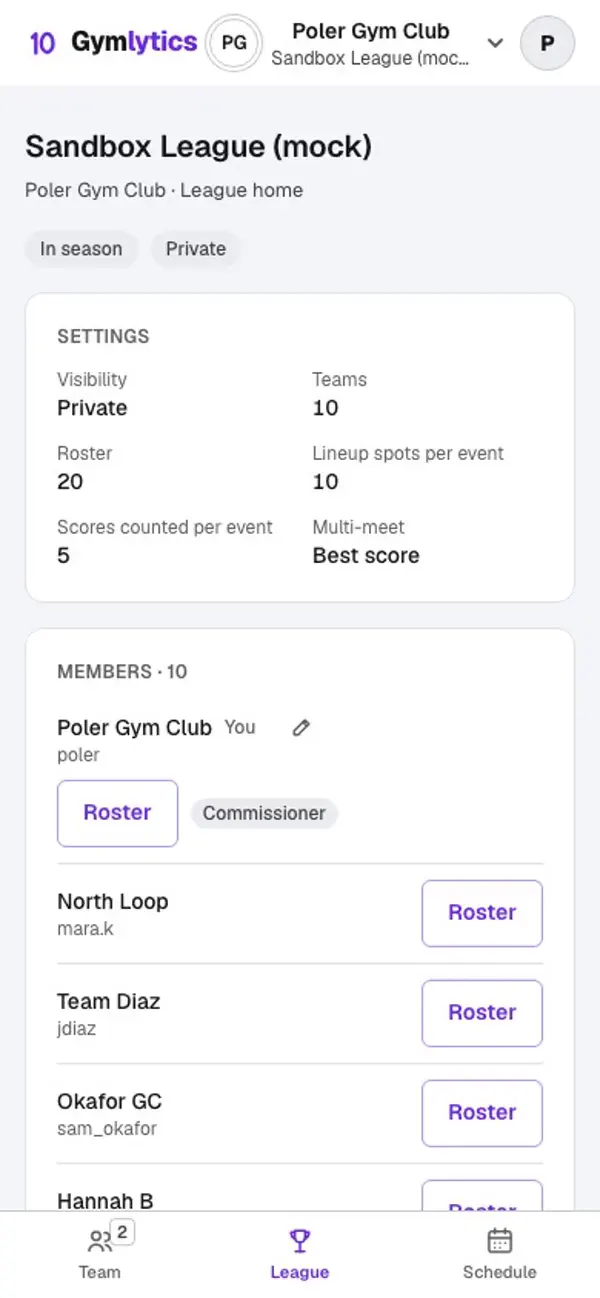
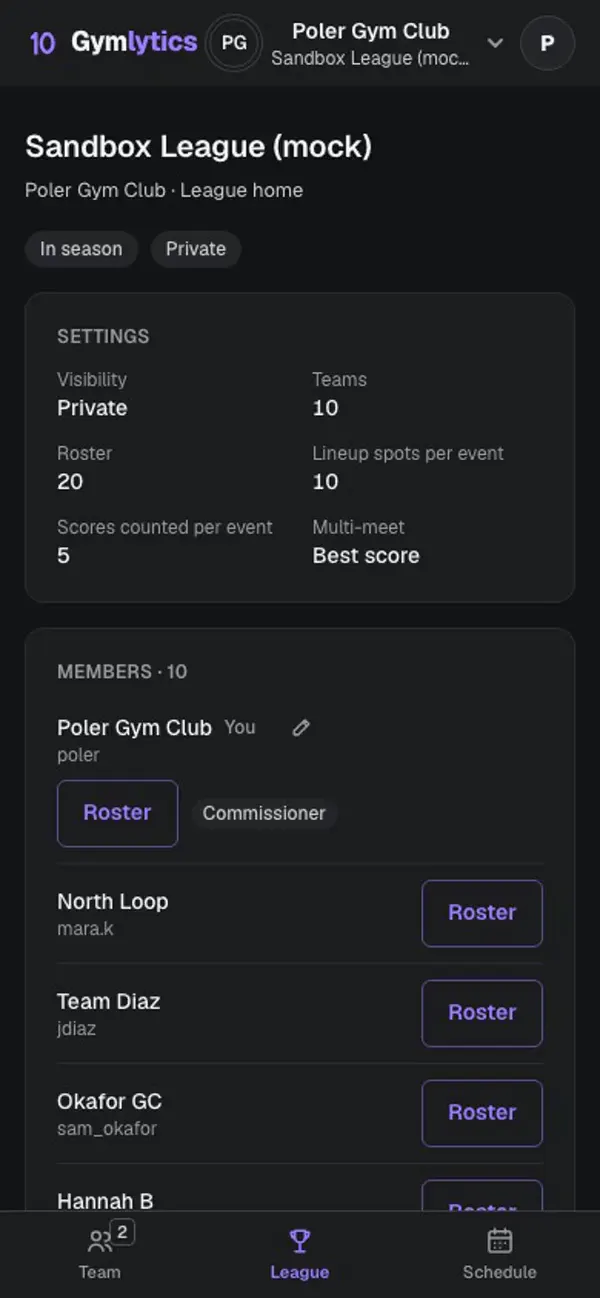
Create it, name it, set the rules, then share the invite code it gives you. You are its commissioner.
Someone sent me an invite code — now what?
Open the join page and enter it; a shared link fills it in for you. You see the league first — its name, its commissioner, how many teams it already has and the rules it plays by — before you accept.
If you already started a team without a league, you can bring it in, ranking list and all, or create a new team for this league instead. Invites only work for the current season’s leagues.
Can I start without a league?
Yes. Start a team on its own and begin building your draft list immediately; join a league or get placed in one later.
I don’t know anyone. Can you find me a league?
Yes — start a team and build its draft list. There is nothing to sign up for: any team that isn’t in a league is placed automatically.
When drafting closes, every such team is placed in a public league with other solo players, and each new league is auto-drafted from its members’ ranking lists. You don’t choose the league, and public leagues can’t be browsed. A league holds one team per person, so if you have several solo teams, each goes to a different league. A league needs at least 2 teams, so a team can only be placed if there are other players to fill a league with. A Freshmen only team waits in a pool of its own and is placed in a Freshmen League, never a regular one.
What is a Freshmen League?
A Freshmen League drafts, claims and adds freshmen only. Scoring, lineups, waivers and trades work as in any other league. A freshman is a gymnast listed as a freshman on her team’s roster, redshirt freshmen included. Eligibility is checked when a gymnast is added: one whose class is corrected later stays on the roster.
Pick Freshmen only when you start a team. When drafting closes, Freshmen only teams are placed in public Freshmen Leagues and auto-drafted, and the leagues get their own public leaderboard. You can hold both kinds of team; the limit on teams without a league counts them together, and a team can switch pools in Settings until drafting opens, while it isn’t in a league.
What does a commissioner get to decide?
How big the league is, how big a roster is, how many gymnasts are up on each event and how many of them count, how a multi-meet week resolves, whether the draft is live or automatic and in what order, and whether trades are on and until when.
Everything on this page described as a default is one of those settings.
Freshmen Leagues are the exception: they are public, have no commissioner and play with the standard settings.
- Start a leagueYou are the commissioner
- Join with a codeA friend’s league
- Start a teamPlaced in a public league later
Drafting
How does the draft work?
Snake order: the pick order reverses every round, so the last pick of one round takes the first of the next. Leagues draft one of two ways, set by the commissioner — automatically from everyone’s ranking list (the default), or live together in a draft room.
Both draft from the same list, so there is nothing extra to prepare for either, and both end the same way: rosters are set when drafting closes, for every league at once.
What is an automatic draft?
You rank gymnasts across a multi-day window. When the window closes, one snake pass walks every team’s list top to bottom and fills every roster at once. Nobody has to be online, and nobody misses the draft.
What happens in a live draft?
The league drafts together in real time on a shared board, with picks streaming in and the on-the-clock team marked. The commissioner chooses the pace: a clock per pick, or untimed and simply next-person-up.
If you are not there — or the clock runs out — the pick is made from your ranking list for you. An absent manager still drafts the roster they ranked for.
Live drafts happen before drafting opens. The commissioner reviews the draft order and starts the room whenever the league is ready; from then on, nobody can join or leave the league. Your picks become your roster when drafting closes, for every league at once — and a live draft that hasn’t finished by then is finished automatically from everyone’s ranking lists, keeping the picks already made.
What is the ranking list, and what if mine is incomplete?
It is your draft board: the gymnasts you want, in the order you want them. It is the same list in both draft modes — in a live room it is your queue, and in an automatic draft it is the whole of your draft.
An incomplete list is fine. Whenever your list runs out or everyone left on it is gone, the draft falls back to the overall ranking of the field, so you never end up with an empty roster spot.
On a Freshmen only team the list holds freshmen only, and when it runs out the draft falls back to a freshmen ranking that takes each school’s next freshman in turn, strongest school first.
Can two teams in my league have the same gymnast?
No. A gymnast is on at most one roster per league, from the draft through every trade and claim after it.
Scoring and lineups
How does my weekly score work?
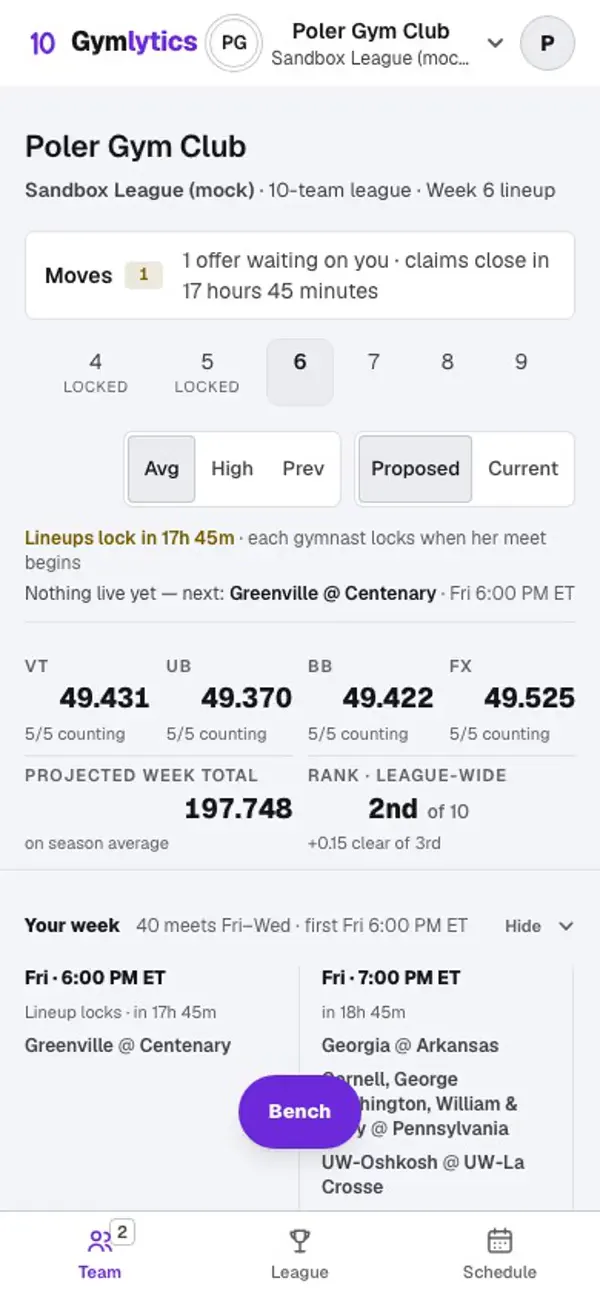
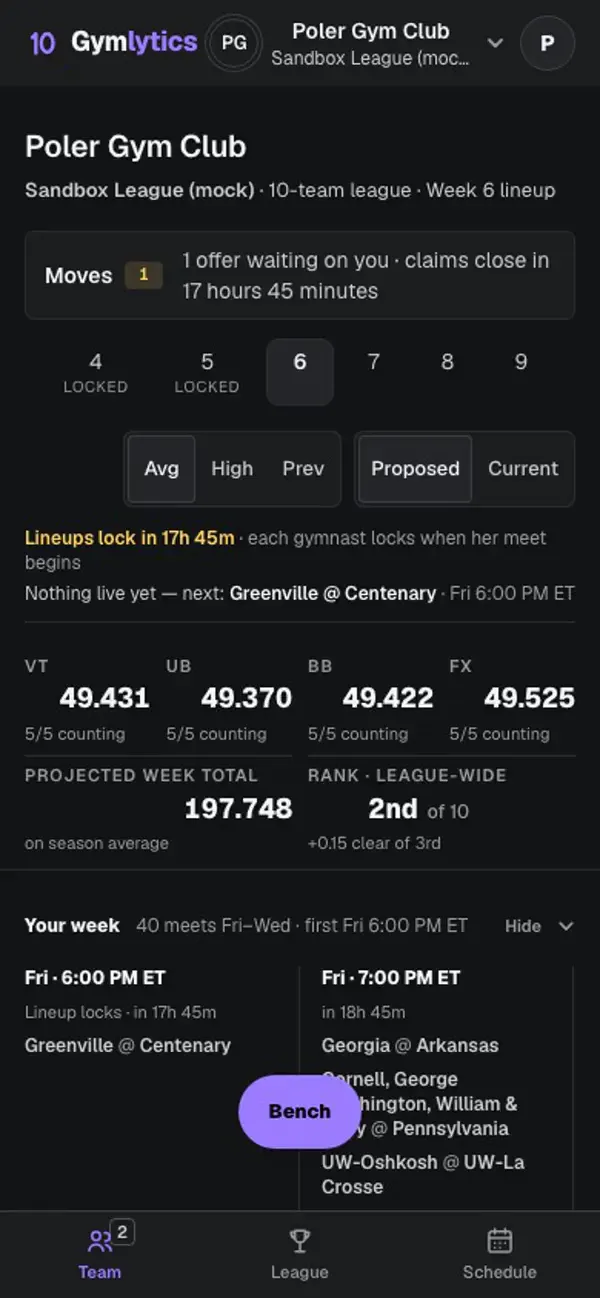
Each week, set who's up on each event — their top 5 scores per event count for you (by default).
Everyone you do not start is on your bench that week and contributes nothing. Starting fewer than you are allowed is not penalised — you simply count what you have.
When do lineups lock?
Lineups lock at the first meet of each week.
That first meet is the deadline every countdown names, but the lock is per gymnast: each one locks when her own meet begins, so a Sunday slot is still editable while Friday’s meets are underway. A gymnast with no meet that week never locks at all.
What if a gymnast competes twice in one week?
A gymnast competing twice in a week counts her best meet.
That is what happens by default. A league may instead resolve it the other way: a gymnast competing twice in a week counts the midpoint of her highest and lowest meet.
How are the standings worked out?
Your weekly total is ranked against your whole league. Season standings drop your two lowest weeks.
The 2 lowest weeks drop once more than 3 weeks are closed.
Once it applies: Each team’s 2 lowest weeks are dropped; the rest are averaged. So a bad week you could not help costs you less than it should, and a season is not decided by one Friday.
What if I forget to set a lineup?
That week scores whatever your empty lineup scores, which is usually nothing — and it is usually one of the weeks the drop rule removes.
Gymlytics nudges you: an event you have left empty raises a flag on your Team tab as the lock approaches.
- Gymnast A9.950counts
- Gymnast B9.925counts
- Gymnast C9.900counts
- Gymnast D9.900counts
- Gymnast E9.875counts
- Gymnast F9.650bench
Beam total, top 549.550
Roster moves in season
Where do roster moves live?
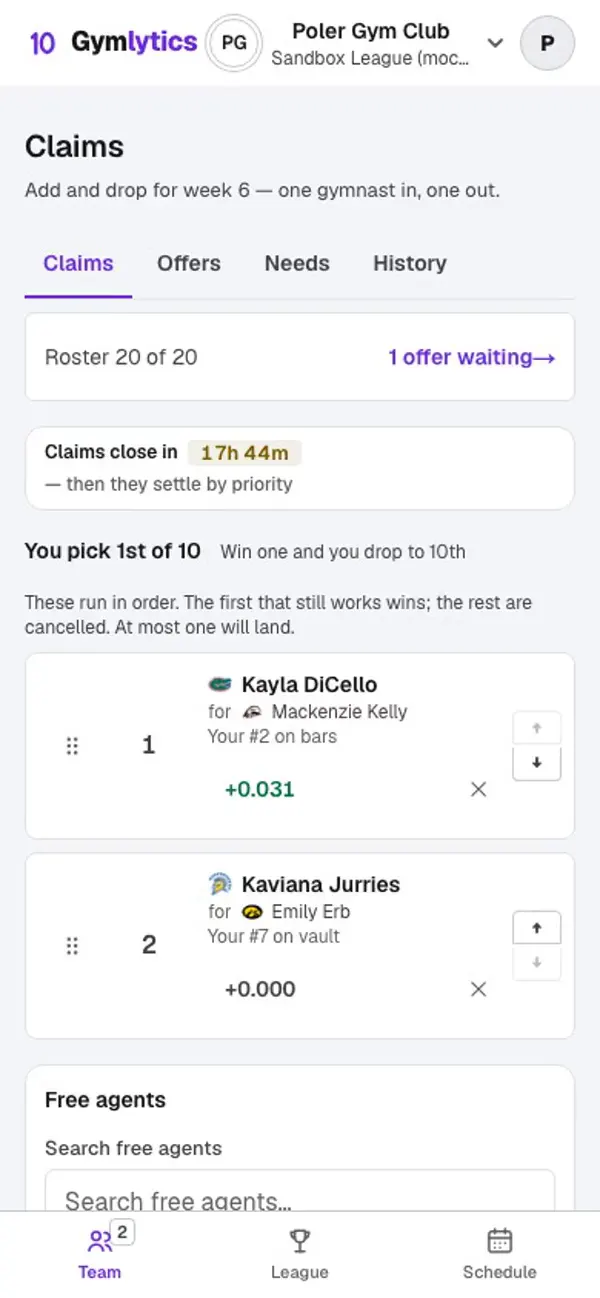
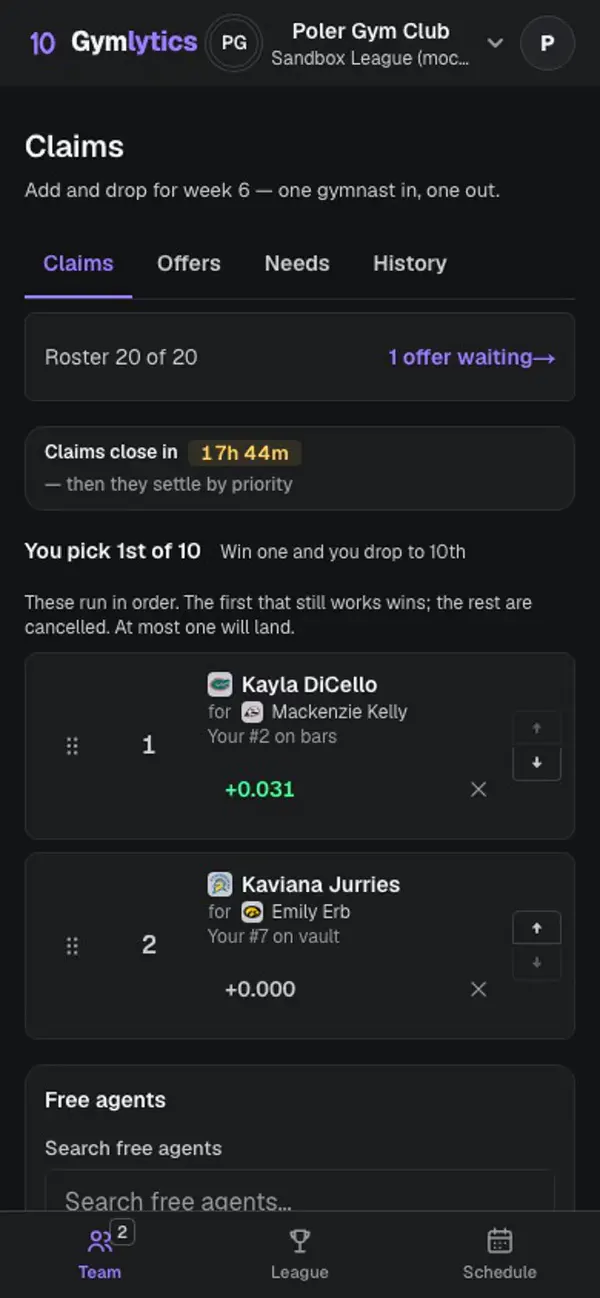
On your Team tab, under Moves: Claims for free agents, Offers for trades, Needs for the league’s trade board, and History for everything that has already happened to your roster.
How do free-agent claims work?
A claim is strictly one add and one drop, together, so your roster size never changes. You stage them as an ordered queue — the first one that still works when the batch runs is the one you get, and the rest of your queue is dropped.
In a Freshmen League the free-agent list shows freshmen only, and a claim for anyone else is refused: “Freshmen League: only freshmen can be added.”
Who wins a contested claim?
League priority order decides it. Each team wins at most one claim per batch, and a team that wins rotates to the back of the order, so priority circulates instead of a single team taking everything.
The starting order is the reverse of the first round of the draft. Your current position is shown on the Claims surface.
When is the claim window open?
A week’s claim window opens when the previous week locks and closes when that week locks. An award therefore always lands while the week you were claiming for is still editable, never after it.
The season’s first week has no window — there is no earlier week to open it, and no meet has been competed to react to.
How do I find out what I won?
Every claim ends in a stated outcome you can read: won, lost, superseded by your own earlier claim, or invalid. You never have to work it out by looking at your roster.
How do trades work?
Two teams in the same league, gymnasts for gymnasts. There is nothing else to trade — no draft picks, no budget. Before you send one you can see exactly what the swap does to your counting lineup.
The moment the other manager accepts, it executes. There is no veto, no league vote and no commissioner review.
What happens to an offer nobody answers?
The proposer chooses how long an offer stays open, and an unanswered one expires on its own with the reason recorded.
An offer is also voided if it stops being possible — if a gymnast in it leaves either roster first, the offer dies rather than executing a trade neither side still means.
I don’t know who to approach for a trade.
Post what your team needs on the league’s Needs board. Other managers can see it and start the conversation from there instead of guessing.
- 1Team D
- 2Team Bwins
- 3Team A
- 4Team Cclaims
- 1Team D
- 2Team A
- 3Team C
- 4Team B
Where the scores come from
Where do the scores come from?
The official NCAA results. Gymlytics reads each meet’s published results and reconciles every routine against them.
Why are scores up before the official results are?
Because people in the arena report them. During a meet anyone can enter scores as they go up, which is what makes a Friday night live — those values are marked provisional until the official results land.
A score was wrong and then changed. What happened?
The official pass corrected it. The official results are authoritative: where they disagree with a reported value, the official value replaces it and becomes official, and the earlier report stays visible in that routine’s history.
Once a score is official it is locked — a later self-report cannot move it.
What if people report different scores for the same routine?
A routine that collects 3 different values inside 10 minutes is flagged as disputed and held for the official pass, rather than flickering between whichever report arrived last.
Does a correction change standings that already happened?
Yes, and it is supposed to. No fantasy total is ever stored — every weekly total and every standing is rebuilt from the underlying scores, so a correction flows all the way through on its own.
- During the meet9.875ProvisionalReported from the arena
- Official results9.900Official · lockedReplaces
9.875; the report stays in the history
Account and help
How do I sign in?
With Google, which is the only sign-in Gymlytics has. The first time, you pick a username.
I played Gymlytics before. Do I keep my account?
Yes. Sign in with the same Google account you used before and your username comes with you. There is nothing to transfer and no new account to make.
Can I change my username?
Yes, in Settings. A username needs at least 3 characters — spaces, emoji and punctuation are all fine — and can’t match someone else’s in any mix of capitals. The form checks whether a name is free as you type. An original Gymlytics username is yours for as long as you want it; changing any username gives it up, and someone else can then claim it.
I signed in on a device I no longer have.
Settings has a sign-out that covers every device at once, not just this one.
Something is broken, or I have a question this page doesn’t answer.
Come to the Discord. Bug reports, help and league banter all live there.
Where can I learn how NCAA gymnastics is scored?
The guides explain the sport: how routines and team scores are worked out, and which events run deep or thin, using last season’s numbers.
Where can I read up before a draft?
The Resources page collects the links worth having — rankings, depth charts, previews and injury news from around NCAA gymnastics.
Every rule here is also shown where it applies: on your lineup, your standings and your draft board.