College gymnastics is scored to the thousandth, and the gap between a good routine and a great one is often less than a tenth of a point. This guide covers how a single routine is scored, how those scores add up to a team total, and how Gymlytics uses them.
The four events
NCAA women’s gymnastics has four events, competed in Olympic order: vault, uneven bars, balance beam and floor exercise. A gymnast who competes all four is an all-arounder; most gymnasts compete on one, two or three.
- 1Vault
- 2Uneven bars
- 3Balance beam
- 4Floor exercise
Every routine is scored out of 10
Each routine gets a score from 0 to 10.000. A 10.000 is a perfect score: every judge on the panel found nothing to take off. Scores are shown to three decimals because the final number is an average of several judges’ marks, which is how you get scores like 9.925.
Start value: the most a routine can score
Before a gymnast moves, the routine has a start value, the highest score it can earn.
- On bars, beam and floor, a routine is built to start from 10.0 by including a set of required elements and enough difficult connections. Leave one out and the start value drops, so even a flawless routine cannot reach 10.000.
- On vault, each vault has its own fixed value. The most common 10.0 vault is the Yurchenko 1½. The Yurchenko full starts from 9.95, so a perfect full still scores 9.950 at most.
Deductions
Judges then subtract for anything that falls short: bent knees or legs apart, a wobble on beam, a step or hop on a landing, a skill that is short of its full rotation. Most deductions are five hundredths or a tenth. A fall costs half a point, which is why one fall usually takes a routine out of contention for the counting scores.
- Bent knees in a back handspring−0.050
- Wobble after a leap−0.100
- Small hop on the dismount−0.050
From judges’ marks to one score
Each judge on the panel gives a mark, and the routine’s score is their average. Most regular-season meets use two or four judges per event. With a larger panel, the highest and lowest marks are dropped first, so one generous or harsh judge cannot move the score much. Postseason meets use bigger panels than the regular season.
- Judge 19.85
- Judge 29.95highest dropped
- Judge 39.80lowest dropped
- Judge 49.90
(9.85 + 9.90) ÷ 2 = 9.875
Why 9.900 and 9.950 are far apart
At the top of the sport, scores bunch together. On beam in 2026, the 10th-best Division I gymnast had a qualifying score of 9.940, while the median gymnast with a qualifying score had 9.810. Most of the field sits within about two tenths of the top, so five hundredths, one small landing step, separates a lot of gymnasts.
How a team score is built
In a meet, a team sends up to six gymnasts on each event and counts the best five scores. The lowest score is dropped, which means one fall does not have to sink the team. Five scores out of 10 make each event worth up to 50 points, and four events make a perfect team score 200. Top teams usually score in the 197s and 198s.
Bars: six up, best five count
- 9.900
- 9.875
- 9.925
- 9.850
- 9.200fall · dropped
- 9.950
The season ranking: NQS
Over the season, gymnasts and teams are ranked by National Qualifying Score (NQS). It takes the six best scores of the season, at least three of them from away meets, drops the highest and averages the other five, so one generous meet cannot carry it. NQS decides postseason places, and it is the number most worth looking at when you compare gymnasts for a draft.
How Gymlytics uses these scores
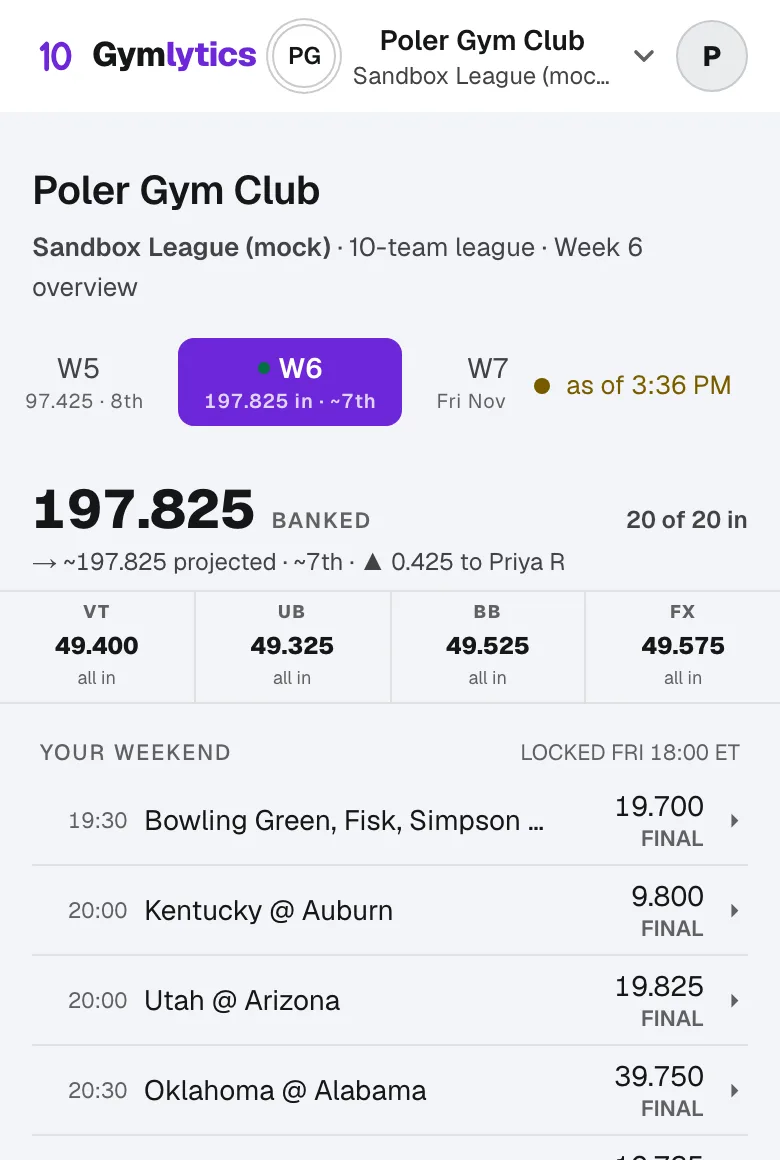
Gymlytics borrows the counting rule. Each week you start gymnasts on each event, and your best scores count toward your total: in a default league you start 10 and the top 5 count, the same top-five idea a real team uses. Your weekly total is the sum of your four events, ranked against every other team in your league. More on weekly scoring in the FAQ.